Branding is one of the most important activities your business can engage in. Building a strong, recognizable brand will help you connect with your existing customers, sell to new ones, and encourage loyalty and recognition.

But like any other business task, successful branding requires careful planning and a smart strategy.

Strategies That Can Improve Your Brand…

1. Make a Good First Impression

Most of us know intuitively, that first impressions are important.

We don’t like to think that we judge a book by its cover or a person by what they are wearing or how they appear, but the reality is that we often do. It’s second nature.

For micro and small businesses (and larger businesses too), what potential customers think about you and how they judge you, is often determined by their first impression.

A first impression based on your outward appearance. Things that are evident right away, before they dig deeper:

  • Your store front location (tidy, clean, organized, messy, modern, dated, caring staff, uncaring staff, etc.)
  • Your website (professional looking as appropriate for your type, loads quickly, well laid out and easy to navigate, helpful content that is up-to-date, mobile optimized and easy to view and navigate on mobile devices, etc.)
  • Your social networks (complete profile, high-quality profile photo and cover image, up-to-date information, active with regularly shared content that is helpful and interesting)

2. Always be Reliable

3. Do A ‘Values Check’

Business Core Value

Branding isn’t about your logo; it’s about your message – what you’re broadcasting to the world.

First, check in with your own values: Does the wording and look and feel on your website, social media profiles and materials match up with those values?

Look to make all your messages and images congruent with your values and the world will notice. So establish strong values and be transparent.

4. Start With Your Value Proposition

Branding is an exercise in establishing an impression about yourself to others, but if you start with branding first, you have a very shallow brand.

By contrast, an authentic and compelling brand starts with knowing your personal value proposition. What does your audience need and how do you fulfill those needs?

If you can answer those questions, your branding will be a natural extension from there.

5. Educate Employees About Your Brand

6. Know Thyself And Align

ask yourself why

The most fundamental part of branding is truly understanding who you are so that you can align all of your actions and your environment.

The deeper your understanding of values, vision, and other brand attributes, the better able you are to align all parts of your life consistent with your brand.

You are the most critical part of your branding strategy.

7. Give Great Customer Service and Exceed Expectations

8. Be True To You

Be authentic to who you are, the values you have, and the skills you excel at. Authenticity is imperative to branding success. Avoid pressure to constantly reinvent yourself or overstate and inflate your message.

A simple articulation of who you are and what you are good at – shared succinctly and clearly – will suffice to nail down your brand.

9. Repeat Your Message Again and Again

10. Use Great Photos

Most small businesses are “personal brands,” meaning you are the face of your brand. The days of the boring head shot are done for most coaches, consultants and service providers.

Use photos of you that reflect your personality and style to make your website and brand stand out from the crowd online. You’ll attract your ideal clients and get your message across with less effort.

11. Display Your Brand Colours and Own Logo Everywhere

12. Define Your Niche

NicheYou can’t be all things to all people.

Narrow your target market by either offering a specialized product or service, or by serving a specific demographic.

Related Article: Determining the Perfect Business Niche for You

There’s a reason brain surgeons get paid more than general practitioners!

13. Display Your Back Story

14. Meet Your Audience Where They Are

If you want to be unique, get your branding right. Address your target market in the places they hang out with the message they expect to hear, using the distribution methods and mediums they like.

It’s a simple formula that many do not follow. Your brand is your identity, and once you have that set, you can get creative with the rest.

15. Listen to Your Customers

16. Stop ‘Selling’ And Be Helpful

Overwhelmed Person Holding aHelp Sign

Your customers don’t want to be treated as though they only represent dollar signs to you.

If you focus on being helpful by crafting well-researched social media responses instead of driving traffic, you can give your brand an edge while building trust.

Prioritizing quality engagement through creating meaningful interactions can lead to loyal customers and sometimes even gain brand ambassadors.

17. Network To Start Conversations And Build Goodwill

The way you talk to customers has a big impact on your brand, and nothing delivers customer satisfaction quite like consistently delightful communication.

When you’re thoughtful about the way you convey information to (and receive feedback from!) customers, that yields better results than any splashy new logo or 25 percent off coupon ever could.

Remember to engage local as well as nationalor even world wide customers.

18. Improve Your Culture

The most visible brand you have is your company’s culture. It’s culture that defines your uniqueness and provides you with a competitive edge.

It’s a social and psychological form of DNA that can become a catalytic mechanism. Your company culture is a key element relative to how people “see” your company.

Since it’s your company’s soul, it’s worth paying attention to.

19. Grow your Brand with your Business

20. Don’t Get Stuck in the Information Age.

The Information AgeLike it or not, we’ve transcended the Information Age.

Welcome to the social business era, characterized by a growing transparency (some of it unintended) that is revolutionizing the way we do business.

“There’s now a distinct overlap—maybe even a full convergence—between three things that used to be separate.
Your brand, your culture, and your leadership style.”

– Justin Foster, author of Oatmeal vs. Bacon:
How to Differentiate in a Generic World

21. Understand the Convergence Between Personal and Professional.

For leaders (certainly entrepreneurs), their personal brand is an integral part of their business brand; their business is a manifestation of what they believe in: their values, goals, and dreams.

It begins with you. Your personal brand is reflected in the business you create and in the team member you choose, which collectively form the culture of your company. In turn, this culture becomes your brand.

22. Stand out from Competitors

23. Don’t Lose your Confidence.

Confidence emerges from self-belief. It’s hard to be different but it’s even harder to be authentic if you don’t believe in yourself.”
24. Don’t Try to Please Everybody.

The biggest pitfall in branding comes from ‘people pleasing.’ In other words, trying to please everyone. A lot of entrepreneurs believe that they have to serve everybody. If being yourself doesn’t rub somebody the wrong way, there’s something off.

Apart from it being impossible to create a message or solution that caters to everyone on the planet, it’d be untrue to you. You can’t do that while still being unique and authentic. Being your own person means that you’ll naturally repel some people. And yes—that’s exactly how it should be.

“You have enemies? Good.
That means you’ve stood up for something in your life.”
– Winston Churchill

25. Have a Long-Tem Vision

26. Rattle People’s Emotions.

A successful brand rouses emotion. It’s riveting. Yes, even controversial. Brand strategists seek to trigger emotional responses from our right brain, the limbic, primal portion of our minds.

A bit of controversy should be inevitable. Just think of brand wars like Apple vs. Microsoft have staunch supporters on each side. Justin summarizes it perfectly: “If you cannot generate emotion, there is no brand.”

27. Continue to Learn

28. Partner With An Expert

Finally, nothing beats getting outside feedback from a branding expert to get clear on your reputation, values, brand and how to best articulate your business and services to your clients.

Conduct an audit of your brand strategy with an expert and, together, align your next steps for your target audience.

29. Become an Authority in Your Field

30. Gain a Reputation

So what’s your branding strategy?

Properly developing and implementing a branding strategy can have a huge impact on the success or failure of your business.

brand-strategy-wheel

Having the right promotional materials, effective marketing messages and visual designs for both online and offline will help you increase sales leads and sales conversions.

If you market with sales letters, fliers, brochures, catalogs or on the Internet, then the message you are sending through your corporate branding, product branding and promotional materials must make an impact.

A common mistake many people make in marketing is not understanding who their target market is, sending the wrong benefit message or no benefit message and then expecting the buyer to figure it out.

Learn more techniques to use to promote your Brand and improve the profitability of your business, check out our proven lead generation system by clicking on this link now.

We are here to help. If you want any help in your Entrepreneurship endeavors, just Messenger us (Private Message Us) at our Facebook Messenger link – m.me/EasyOnlineBizSolutions

Get ACCESS to the best FREE tools and resources for entrepreneurs and business people by going to our tools and resource page or Subscribing to our Entrepreneur Newsletter.

Remember a logo is not a brand. A branding strategy is a vital step in creating your product or business identity.

Talk Soon,
Nicky and Dave

Businesspeople often get confused when talking about their marketing, particularly with regard to brands and branding.

There’s a lot of confusion out there about brands and branding.

What’s a brand?
What’s the difference between your brand and branding?

Well, allow us to clarify things for you.

What is a Brand?

Brand = Branding + Interaction/Experience

Strategies to Improve Your Branding

A brand isn’t a logo. Or a brand name or product name. In fact, it isn’t any one thing.

Your brand is everything. It’s the perception of your company, products, and services in people’s minds. It’s how people think and feel about who you are as an organisation and what you do.

Your marketing and branding clearly influence that perception, but your brand exists whether you actively market your business or not. If you’re out there and people are interacting with your business, you have a brand.

It’s our job to use marketing and branding to manage the perception of your brand – to change the way people think and feel about your organisation and, in turn, change their behaviour.

What is Branding?

Branding is the act of creating a brand.

The Process Involves:

  • Positioning your company or product in the market (carving out your own place)
  • Devising brand strategy (how you will reach your goals)
  • Creating your name (your verbal identity)
  • Designing corporate identity or product identity (your visual identity)
  • Writing brand messaging (verbal and written tone)
  • Setting brand standards (how you keep your brand consistent and strong).

When branding (brand development) is completed, most businesses will not have to undertake the branding process for roughly 10-20 or more years if they worked with an experienced professional.

branding process

In the life of a 50-year business, branding the company occurs only 2-3 times total.

When a company’s brand becomes outdated in 20 years, then you may once again need to take on the branding process. If you create new products or launch new companies, you get to enjoy the exciting process of branding on a more frequent basis.

Branding is Done by:

  • Creating an affinity or emotional connection with the consumer
  • Providing justification for paying a premium price for a service or product
  • Creating loyalty to the product or organisation
  • Demonstrating the quality and benefits of a service or product and the company behind it.

Once the branding process is completed, the word ‘branding’ has no continuing relationship to your brand (unless you work with cattle).

Acquiring loyal customers is what many successful businesses strive for, and that’s what the marketing strategy called branding is all about.

Confusion Around Brands and Branding!

Brand vs Branding

Much of the confusion stems from two scenarios:

  • Branding Consultants with a limited understanding of marketing; and
  • Advertising and Marketing Consultants with a limited understanding of branding.

Consequently, it has confused audiences by coining often self-contradictory buzz-words and using them superficially or out of context. Not surprisingly, the marketplace is left confused and sceptical.

The difference between brand and branding is that one is a marketing tool and the other is an action.

It’s as simple as that.

Branding encompasses much more than the visual realm.

It’s the process of influencing the perception of a business or product, and any sensory experience can be used as a branding opportunity. Audible and emotional communication are very much part of the process. It can play a significant role in forming an impression of a company.

It’s better to implement some level of strategic branding than none at all.

brand-strategy-wheel

By creating a real marketing communication tool you can empower your entire organization to communicate with greater purpose and clarity.

Knowing this enables people to be well-informed, and to impart better understanding, which leads to less confusion, clear communication, and better customer service.

Understanding the difference between brands and branding helps you have a stronger brand because you will be more personally invested in the brand development process.

Your understanding also helps your employees grasp the full significance of the brand, so they learn how to best utilize it in marketing, selling, and supporting your goals and initiatives.

If you’d like to have instant access to even more branding and marketing tips, as well as a way to generate conversion-ready online marketing prospects each month, click here to learn about our done-for-you system.

We are here to help. If you want any help in your Entrepreneurship endeavors, just Messenger us (Private Message Us) at our Facebook Messenger link – m.me/EasyOnlineBizSolutions

Get ACCESS to the best FREE tools and resources for entrepreneurs and business people by going to our tools and resource page or Subscribing to our Entrepreneur Newsletter.

Talk Soon,
Nicky and Dave

Do you have a hobby you wish you could indulge in all day?
An obsession that keeps you up at night?

Now is the perfect time to take that passion and make a living doing what you love.

In Gary Vaynerchuk’s book Crush It!: Why NOW Is the Time to Cash In on Your Passion, you will learn how to harness the power of the Internet to make their entrepreneurial dreams come true.

Online marketing guru Gary Vaynerchuk tells business owners what they need to do to boost their sales using the internet. He would know as build his family’s wine store from a $4 million business to a $60 million.

This book is comes in a trilogy of the evolution of social media – the other two are: “The Thank You Economy” and “Jab, Jab, Jab, Right Hook” (read my summary) which are a great read too.

Let’s Begin with My ‘Crush It’ Book Summary:

Build Your Personal Brand

Branding Matters

Developing your personal brand is key to monetizing your passion online.

When you’re selling a very similar product/service/content to someone else, it’s your personal brand and liveability that will set you apart and keep people coming back.

It’s a must to build authenticity through your content.

Your personal brand will help determine which channels you’re going to use to market yourself.

For example, podcasting and video favours someone outgoing. But if you’re shy and lack confidence, then perhaps writing is more your thing – that’s more me.

Summarise your personal brand in a sentence. How are you different?

Create Great Content

To everyone who is freaking out because they fear the noise and distraction of all the additional content on the Internet, you can relax.

Quality is a tremendous filter. Cream always rises, no matter how many cups of coffee you pour.

“Talking about what you love brings passion to the table. You come across more credible and entertaining when you talk about the thing you love. You also won’t need a script” – Simon Sinek.

To monetize your personal brand into a business using social marketing networks, two pillars need to be in place: product and content.

Great content is what you’re going to pump into your social media networks to draw eyeballs to your blog. It exists as a result of passion plus expertise, so make sure you can talk about your product like no one else.

If you could talk forever about it then you’ve picked the right product. No matter what it is. Stories are a great way of communicating content.

Ask yourself:
“Is marketing/tech/ sport my greatest passion?”
“Can I be the best blogger about this subject?”

The answers should both be ‘yes’.

You can monetize any passion, but the level at which you can monetize will be affected by the size of your niche and whether you are able to differentiate yourself enough from the other players in it.”

First, you must know yourself. Choose the right medium, choose the right topic, create awesome content, and you can make a lot of money being happy.

Passion is Everything

“Passion is energy. Feel the power that comes from
focusing on what excites you.”
-Oprah Winfrey

Golden rules for success:
1. Love your family.
2. Work super hard.
3. Live your passion.

You should measure your success by how happy you are, not how big the business is or how much money you’ve made.

If you’re going to live and breath your business and personal brand, you have to love what you do. This is what will set you apart from the rest and make you jump out of bed each morning.

The Internet makes it possible for anyone to be 100 percent true to themselves and make serious cash by turning what they love most into their personal brand.

Storytelling is by far the most underrated skill in business.

Storytelling

Choose Your Platform

When someone re-tweets what you say, they’re saying you’re worth paying attention to. You’re in business to serve your community.

Don’t ever forget it.

AUTHENTICITY:
Being authentic, and being perceived as such by your audience. This relies on your ability to ensure that every decision you make when it comes to your business is rooted in being true to yourself.

HUSTLE:

Hustle Mode is OnI’ve said over and over that if you live your passion and work the social networking tools to the max, opportunities to monetize will present themselves.

With one exception.

Someone with less passion and talent and poorer content can totally beat you if they’re willing to work longer and harder than you are.

So Hustle! Without it, you should just pack up your toys and go home.

PATIENCE:

Building a business and success takes time.
You have to live your passion. Think of building a business as a marathon, not a sprint.

You have to love what you do as it’s the only way you’ll keep going. And even if you fail, you won’t have any regrets because you were doing what you loved.

Create Community: Digging Your Internet Trench

Volunteering in the Community

Creating a community is where the bulk of your hustle is going to go and where the bulk of your success will be determined.

Comment on other blogs and get a conversation going. Link back to your content. Also, comment when people reply to you.

It’s the quality of the conversation and community that matters most.
Not the numbers.

Nothing in life ever goes exactly the way you think it will, and that goes for all of your carefully planned entrepreneurial dreams and goals. Reactionary business allows you to make a couple of crucial moves when the landscape starts to change.

Legacy is Greater Than Currency

Legacy is Greater than Currency

“This is why every decision I make I weigh in terms of currency and legacy. Will this business deal make me money? Yes? Good. Will I be proud of how I made that money? Yes? Okay, then, let’s do this. If the answer is no, I don’t go there, ever. Legacy always wins.”
– Gary Vaynerchuk

Follow your passion, not the money.

Now that you’re in the public eye, you have to be careful with how you interact and respond to people. The internet is not very forgiving.

Think through every business decision before you make it. Take a long-term view.

The Time is Now, the Message is Forever

Time Management

The book is only a blueprint for how to act and what to do. But when you read it, the world will already be a very different world. Roll with the changes.

If there’s any message I want you to take away, it’s that true success—financial, personal, and professional—lies above all in loving your family, working hard, and living your passion

The Steps to Building Your Personal Brand

1. Identify your passion.
2. Make sure you can think of at least fifty awesome blog topics.
3. Answer the following questions:
1) Am I sure my passion is what I think it is?
2) Can I talk about it better than anyone else?
4. 
Name your personal brand.
You don’t have to refer to it anywhere in your content, but you should have a clear idea of what it is.
5. Buy your user name—.com or even .tv.
6. Choose your MAIN Medium:
video, audio, or the written word.
7. Start a WordPress or ClickFunnels account.
8. Hire a Web designer.
9. Include a Facebook Connect link, Call-to-Action buttons, Share Functions, and a button that invites people to do business with you in a prominent place on your blog.
10. Create a Facebook fan page.
11. Sign up for a Social Media Management Platform –
Buffer or Zoho Social (I love this one).
12. Select all of the platforms to which you want to distribute your content. Choosing Twitter and Facebook is imperative (vital); the others you can select according to your needs and preference.
13. Post your content fairly regularly.
14. Start creating community by leaving comments on other people’s blogs and forums and replying to comments to your own comment.
15. Use Twitter Search (or Search.Twitter) to find as many people as possible talking about your topic, and communicate with them.
16. Use BlogSearchGoogle.org to find more blogs that are relevant to your subject.
17. Join as many active Facebook fan pages and groups relating to your blog topic as possible.
18. Repeat steps 13 through 17 over and over and over and over and over.
19. Do it again.
20. And again.
21. When you feel your personal brand has gained sufficient attention and stickiness, start reaching out to advertisers and begin monetizing.
22. Enjoy the ride.

If you like Crush It Book Summary then here is the link, so you can read the full book too.

Crush It By Gary VaynerchukThe book “Crush It!: Why NOW Is the Time to Cash In on Your Passion” gives a detailed blueprint of internet marketing which is not entirely covered in this summary.

If you are looking to be present everywhere on social media, I suggest you should buy this book.

Now the best Entrepreneurs learn how to use attraction marketing effectively. Attraction marketing is the concept of leading with value to attract your perfect prospects to you. We recommend that like us and our mentors that you check out the affiliate program that teaches Entrepreneurs attraction marketing and much much more.

Get Our Bonus Offers!

Learn How a Beautiful Image and a Simple 3-Step FaceBook Ad Strategy Got 7,195 Targeted Page ‘Likes’ in 30 Days
FaceBook Paid Marketing Secrets Course
Get FREE Course Here!

Extra Bonus: 21-page PDF download to get your first FB ad LIVE, and get leads for your business today!
(case study + PDF valued at $297)

We are here to help. If you want any help in your Entrepreneurship endeavors, just Messenger us (Private Message Us) at our Facebook Messenger link – m.me/EasyOnlineBizSolutions

Get ACCESS to the best FREE tools and resources for entrepreneurs and business people by going to our tools and resource page or Subscribing to our Entrepreneur Newsletter.

Talk Soon,
Nicky

“The real advertising writer who is after results makes the reader want something – and then provides what the reader will
consider a good excuse for buying it.”

~ Clyde Bedell

For the lead singer of the Beatles, John Lennon, writing hit songs was the way to get what he wanted in life.

“Okay, let’s write a swimming pool” he said famously to his friend Paul McCartney. If a new song was a hit, he’d have the money he needed to buy the things he wanted.

John Lennon and Sir Paul McCartney

The same concept that got John Lennon his swimming pool (and many other nice things) can get you all the things that are important to you. But instead of hit records, you can write winning advertising campaigns and sales copy.

We’ve had many ads… but, there’s a small handful of them which have outperformed the rest.

Spending your time thinking about, crafting, and testing new ads is some of the most important work you’ll ever do as an entrepreneur.

No matter what, staying focused on the part of your business which brings in new leads- your ads – must be an absolute priority.

And very few people will be able to do it as well as you can as you know your business and target market, because you know your market so well.  You know what makes them tick, and what they’ll respond to.

To Write Great Copy ONE MUST:
Grab their Attention -> Make them Interested ->
Create Desire to Learn More -> Make Them to Take Action.

We have a 7 Step Guide for you to Follow so you can Start Writing Great Sales Copy which will make people want to give their money to you, so you can get what you want:

Step One: Start with a Big Promise.Trust

Brainstorm as many as you can. When you can’t come up with any more, review your list until you find the biggest and best promise.

That’s the one to use.

Step Two: Paint a Vivid Picture.

Use expressive language to make it real in the minds of your prospects. Get them to see what you see.

Selling is a transfer of emotion, so the more intensely you believe in something and the better you paint the picture of what you believe, the more real it becomes to them.

Step Three: Give Them Proof.

Back up your claims. Although selling is an emotional activity, people need to justify their decision with solid facts.

Step Four: Tell Them WHY it’s Unique.

There must always be something unique about you, your company, and your products or services.

You must differentiate or die. If you can’t think of anything unique about your business or what you sell, it’s up to you to create the uniqueness.

Find or develop points of differentiation that are important to your prospects.

The more unique your product/service is in ways that are important to your marketplace, the more selling power you’ll have—and the more people will be ready, willing, and able to give their money to you.

Step Five: Close by Telling Them Why They Must ACT NOW.

People need good reasons not to postpone their buying decision.

perfect-call-to-action

Remember, your competitors (both indirect and direct) are also trying to win the business of the same prospects you’re after.

You must do everything possible to be heard above the crowd.

Create a sense of urgency, providing clear and compelling reasons why they must buy now.

If there are no such reasons, you must create them—and they must be credible. The more good reasons you give people to take action immediately, the more money you’ll make.

Step Six: Make Them a Special Offer if They Respond Now.

limited-offer-300x300

This becomes one of their biggest reasons for responding immediately.

Offer free bonus gifts that are exciting and valuable to them, and emphasize that those things are only available for a limited time.

Take Use 6 Steps to Creating a KILLER OFFER that Converts and that will increase their sense of urgency.

Step Seven: End with a Reminder of Your Promises.

Provide a complete summary of the offer, simplifying it as much as possible.

Make the strongest possible call to action, doing everything you can to persuade them to give you their money now.
Want a Pool like John Lennon?

A good sales letter (and accompanying well-written campaign) can make you all the money you need to put in a pool… buy a house… donate to your favorite charity… or do whatever else is important to you.

Control Your Prospect’s Mind thru the Deadly Art of Copywriting!

Learn Copywriting and Do it yourself with Million Dollar Copy

million dollar copy

How to become a six figure copywriter – 7 short videos on becoming a great copywriter.

This Copywriting training is part of a huge library of training from online business to Entrepreneurial and personal development training. They come as video and or audio files in a bundle.

You purchase the bundle in this case it is the G500 Pack. You own all the tracks. AND own the licence to resell them. Which means with one referral sale you have the cost of the G500 back. Yes 100% return and you still keep the recordings.

Learn more about the G500 Training Library and Million Dollar Copy

To Write Great Copy ONE MUST:
Grab their Attention -> Make them Interested ->
Create Desire to Learn More -> Make Them to Take Action.

Happy Writing!

Talk Soon,
Nicky and Dave

With the onslaught of blogs, discussion forums and user-generated media it has changed the flow of information about people, products, and brands forever. Anyone with a computer, a video camera or even a cell phone can post information, reviews, and comments about you and your brand on dozens of highly visited online destinations.

It’s no longer enough to create a website and assume that prospects will learn about your company solely from there. In today’s online social media world, businesses of all shapes and sizes must actively participate in online reputation management.

For small businesses having a good reputation is important to compete against larger competitors. Especially with the increase in online activity. With the introduction of the Internet, many small businesses have to compete harder to maintain their position with their customers.

Did you know:

  • 85% of your potential customers use the internet to research your company before they decide to make a purchase.
  • 79% of your potential customers value personal and online recommendations in their search for a reputable company.

So What Does This Mean if You’re a Business Owner?

It means that managing your company’s reputation both online and offline has never been so important.

Reputation is critical to a business. A business that acts in an unethical way suffers on many levels including financial (fines, loss of revenue), valuation decreases, branding (distrust) and public relations. Trust is the cornerstone of a successful business and once a brand loses trust with its customers, it can take years to recover if ever.

“It takes 20 years to build a reputation and five minutes to ruin it. If you think about that you’ll do things differently.”
Warren Buffet

In order to help your online reputation, you will need to build a web presence. This allows customers to compare you to your competition. It also helps clients to understand what your business is about while providing a few advantages along the way which include:

  • Building Customer Trust – Positive online reputation will increase customer trust overall. You will develop authority, expertise and credibility in your field in the eyes of your customers. The more you gain the trust of your customers, the better the reviews and the increase in customers you will gain.
  • Brand Exposure – Building and managing your reputation can also help to promote brand exposure. The more people know about your business the more likely they will shop with you.

Of course we know the best way to manage your online reputation from a business standpoint is to put out great products, provide excellent customer service and honor all your commitments. That’s certainly a great start, but you may still need to monitor and respond to what’s being said about your organization.

Reputation management, however, is not simply about responding to the negative; it’s equally important to amplify the positive.

The only way to control what people say about your company is to be part of the conversation.

Ways to Manage Your Reputation – Get Started…

Local Reputation Management

  • Sponsor local fun runs, sporting events or other entertainment avenues to show the local public your committed to the community.
  • Donate time, money or services to a charity event to help raise money for a good cause. Businesses who participate in activities such as this are more recognised in the public eye.
  • Handle negative feedback and comments politely and constructively. Always offer a positive reply in return. Handle each one individually and address their concerns, disappointments, or negativity politely.

Volunteering in the Community

Savvy Businesses realize that the best thing they can do is to serve their community, irrespective of whether or not someone is in a buying cycle. One of the most important tools that you can use is community.

There are 11 Benefits that Communities can give to Your Business – Read Them Here!

Online Reputation Management

Networking with Community

Build Your Reputation.

There’s a number of sites that are launched with the sole purpose of allowing you to build an online reputation by inviting people to write reviews about you and your work. LinkedIn is an professional networking community that allows and encourages this practice.

Respond to positive and negative reviews on different review websites.

90% of what people say will impact your business and their buying decision. Take the time to respond to as many reviews as possible. Thank them for the review, respond to the feedback, and encourage them to continue shopping with you.

Want to Get 5-Star Reviews and Block Negative Reviews?
Want to be No.1 on Google?

Right now, Easy Online Biz Solutions and Find Net Solutions are running a promotion so you can get a FREE Holiday with every Rapid Reviews Reputation Marketing Program.

Don’t miss out. We don’t know how long we will be running this promotion.

Participate in Social Media to Build and Manage Your Reputation.

Social media is a powerful tool that can work wonders for your business when used correctly. Use posts to interact and engage with the customers by answering questions, asking questions, or replying back to positive or negative comments. This is important as customers will see you’re committed to good customer relations.

One of the best ways to combat negative comments is to make sure you have lots of positive content showing up for searches of your name or company. Best practices such as creating well-written LinkedIn and Facebook profiles, and writing and submitting articles to article directories can help assure that you have a lot of positive content attributed to your name online.

What's Social Media Marketing?

Looking for more Easy Online Social Media Marketing Training for Facebook, Instagram, LinkedIn, Pinterest, YouTube and with coaching?

These G500 online training courses are for people that are beginners or intermediate Social Media Marketers. These courses could also be a great offer for your customers if it suits your businesses adjectives.
Become an Affiliate Today!
For a LIMITED Time…. We are offering FREE one on one coaching with your choice of Social Media training module from G500 Training!

Host and Keep Updating a Blog.

A blog with frequently updated content and information is a great tool. By starting a blog and inviting customers to leave comments you can keep an eye out for an potential issues. If customers have an issue, and you help them get the answer by way of your blog, you may turn that issue into something positive and stop them from posting negative comments elsewhere.

Brand

If they leave a completely untrue or hateful review on your blog, it may be best to either remove it or answer it tactfully.

Also, we recommend to ask to be a guest blogger on another site in your niche and accept high quality work from others for your site too.

Build Multiple Business Profiles and Employ Social Search Engines.

Claim and enhance your business listings on search engines such as Google Business, Yelp, InsiderPages, and Better Business Bureau.

These sites enhance your business listing and allow users to rate your services and write testimonials. The best thing you can do on these sites is create a great profile and encourage your customers to post positive reviews.

More of these reviews are being picked up by search engines like Google and shown in their local directories.

Sign up for News Alerts.

Google allows you to set up custom searches on Google News for any phrase, such as your name.

When you subscribe to this search, either via RSS or e-mail, you’ll receive an alert anytime your search phrase shows up in the news. If you need to closely monitor what’s being said online in real time, use Twitter’s search.twitter.com feature.

Once you have created a strong online and offline reputation, it’s time to market your company.

Looking for more Easy Online Social Media Marketing Training for Facebook, Instagram, LinkedIn, Pinterest, YouTube and with coaching?

These G500 online training courses are for people that are beginners or intermediate Social Media Marketers. These courses could also be a great offer for your customers if it suits your businesses adjectives.
Become an Affiliate Today!
Use Your Smartphone to Make Money OnlineFor a LIMITED Time….
We are offering FREE one on one coaching
with your choice of Social Media training module from G500 Training…
You can get 100% of your outlay for ALL the training courses
back with ONE referral….

Plus see how to make $1,000 within hours with a simple Get the Paid First Affiliate Program Here!

If you want or need any help connect with us on one of our social media platforms or on our contact us form!

Managing your business’s reputation is crucial to whether your business will be successful. By following the tips and tricks above you can easily generate the reputation you’re looking for while maintaining credibility with your customers. So how is your business reputation fairing in this competitive world?

Talk Soon,

Nicky and Dave

In the marketing world, niche terms and metrics get thrown around frequently, and while there is some jargon that you can just shrug off, there are others that you should pay attention to, which brings me to the topic i’d like to discuss today: Customer Lifetime Value (CLV).

This is a metric that is often misunderstood and, even more often, overlooked completely.

In my article Know The Marketing Metrics – They Will Either Make You or Break You we touched on why Customer Lifetime Value is an important Marketing Metric to track.

In a nutshell, Customer Lifetime Value is the calculation of what a customer might be worth to your business over the course of doing business with you, perhaps over the course of a few years as opposed to a single transaction.

Know The Marketing Metrics for Your BusinessThis number might change the way you look at how much you are willing to invest to get each new customer, so as you can see, it’s an important number to follow.

Once you understand the lifetime value of a customer, you can determine how much you’re willing to pay in new customer acquisition costs.

This change in point of view often leads business owners from viewing marketing as an expense to viewing it like the investment it can be. Of course, there are many factors that impact CLV over and above simply measuring it.

Who Should Care About Customer Lifetime Value

For businesses that offer a customer multiple transactions over time, the concept of Customer Lifetime Value is pretty significant.

For businesses such as home builders, who might only work with a customer once in their lifetime, this concept might not seem to matter. Seem being the keyword in that sentence.

Customer ReferralsIn my opinion, the lifetime value of every customer, including those who make a one-time purchase, is unlimited because of the potential for referrals they can make.

A happy, single-transaction customer might be a source of business for years because they are likely to talk about your business and recommend you to others.

How to Calculate Customer Lifetime Value

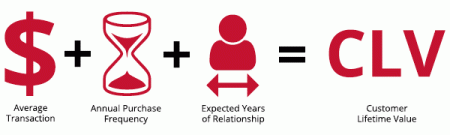
There are many ways to calculate lifetime value — from the simple to complex, basic math to calculus. A Simple Customer Lifetime Value Formula looks like this:

Customer Lifetime Value Formula

The moderate Customer Lifetime Value complexed formula that I use is:

LTV = M x R

LTV = Revenue from each paying customer per month, multiplied by Gross Margin (amount left over after the cost of goods sold), divided by Churn (percent of people who leave).

Let’s break that down a bit.

  1. Computer your average sale and gross margin of profit – we’ll call this number M (margin)
  2. Determine the average number of sales, transactions, renewals, etc you can expect over some period if you keep your customers happy – we’ll call this number R (repeat, renew)

A more complex Customer Lifetime Value equation employs the net present value of future payments and looks something like this:

Complex Customer Lifetime Value Equation

In my experience, marketers don’t always have to use the most complex Customer Lifetime Value calculation to derive value from CLV. A simple to moderate approach can suffice in many situations.

Myself I use this formula:

LTV = M x R

Example: You might have a $2,000 product, and on average you could make about $500 off of every transaction, and have someone buy on average 4.75 times over the course of the relationship.

Then it could be said that the CLV = $2,375 or $500 X 4.75

Now, with that number in mind you can make some decisions:

  1. Am I investing enough if acquiring more customers?
  2. Could I find more products and services to sell?
  3. Could I find ways to create more frequent transactions?
  4. Could I find ways to get more referrals from these happy customers?
  5. Should I adjust my current pricing based on generating more sales or more profit?
A few notes for calculations purposes:
  • Try to establish your baseline CLV # (where it stands today), so you have something to go to work on.
  • The R # in the equation is a huge variable and can include transactions, renewals, upsells, new products, special offers, etc. It’s the number you can impact the easiest with your marketing efforts.
  • If you have happy customers, there’s a very good chance 20-25% of them would like to buy more – substantially more. Go to work on that and make it a strategic initiative as soon as possible.

Here are some more suggestions on how to think about the relationship between CLV and Customer Acquisition Cost:

  1. Your average sale and your profit per sale
  2. How much additional profit a client is worth to you by determining how many times he or she comes back
  3. Precisely what a client costs by dividing the marketing budget by the number of clients it produces
  4. Compute the cost of a prospect the same way
  5. How many sales you get for so many prospects (the percentage of prospects who become clients)
  6. The marginal net worth of a client by subtracting the cost to produce (or convert) the client from the profit you expect to earn from the client over the lifetime of his or her patronage

These are recommended by Jay Abraham, author of Getting Everything You Can Out of All You’ve Got.

Jay Abraham - Getting Everything You Can Out of All You’ve Got

Regardless of how long the average lifetime of your customers is, Customer Lifetime Value helps you determine how much you can spend for acquiring a new customers as well as how much you can spend to keep your current customers.

How to Increase Customer Lifetime Value

Here’s why I love this metric. By focusing on this North Star kind of metric it gives you lots of room to look at every aspect of your business. As many times this number can increase by simply creating a better customer experience.

To improve your businesses Customer Lifetime Value across the board, you need to take care of your customers and ensure that they are loyal to you.

loyalty-and-trust

A few ideas to do this include:
  • Improve Customer Service – Provide your customers with the ultimate customer experience. This will help them to become repeat and loyal customers and will increase your odds of referrals.
  • Solve Your Customer’s Problems – Remember, customers care about their interests, not yours. Make all marketing efforts and outreach client-centric and address their needs and pain points.
  • Show You Know Your Customers Do thisby sending them something they didn’t even know they wanted. This personalization shows that you care and helps to build trust and relationships with your audience.
  • Listen to What Your Customers Have to Say. Also keep them informed when a change is made based off of their feedback
  • Provide Value even when it’s outside of your wheelhouse (this is why you should build a network)
  • Reward loyalty – Make them know how much you appreciate them being brand advocates. You should appreciate all that loyal customers do for you, and it’s important that you show that.
  • Feature Customers in Your Content or Give them Shout outs – make them feel special

Essentially, your marketing campaigns should nurture current customers as leads. If your lead nurturing endeavors are successful, then your average Life Time Value should increase. If it isn’t, then you know that you need to make adjustments in your lead nurturing endeavors.

The higher your Customer Lifetime Value is, the better off you are regarding acquisition costs. The high value means customers stick around and maintain a relationship with you. Which can lead to consistent referrals moving forward.

Hopefully, based on the information I’ve provided above, you’ve realized that this is a metric that can’t be ignored for all businesses. However its especially important for small business that need to pay attention to their bottom line.

So, let me ask you, are you tracking Customer Lifetime Value?
If not, it’s time you start.

Looking for more Marketing Training?

Do You Want to Learn $$$ as You Learn?

Your-Dream-Business-Automated-Done-for-you-450-sqGET INSTANT ACCESS to Easy Online Social Media Marketing Training for Facebook, Instagram, LinkedIn, Pinterest, YouTube and with coaching!

PLUS have access to ‘One Click’ integration for Leads Ready to Buy… Make Money while You are Learning how to do target marketing eg on Social Media and then scaling up conversions.

These G500 online training courses are for people that are beginners or intermediate Social Media Marketers. These courses could also be a great offer for your customers if it suits your businesses adjectives.
Become an Affiliate Today!Check it OutFor a LIMITED Time….
We are offering FREE one on one coaching
with your choice of Social Media training module from G500 Training!
You can get 100% of your outlay for ALL the training courses
back with ONE referral….

Plus see how to make $1,000 within 24 hours with a simple Done-For-You Business System. Get the Paid First Affiliate Program Here!

If you want or need any help connect with us on one of our social media platforms or on our contact us form!

Talk Soon,
Nicky

Your business’ lifeblood is its customers. In order to gain enough customers to keep your business growing, you need to attract people’s attention; this requires a solid marketing campaign.

However, we regularly see marketers making the mistake of thinking that a “good” marketing campaign means flooding various channels with clever advertisements. In truth, though, good marketing begins when you look before you leap into any action.

In other words, you need to use marketing metrics to guide your marketing campaign’s direction. Here is why how you use — or ignore — marketing metrics can make or break your business:

Why are Marketing Metrics so Important?

Know The Marketing Metrics for Your BusinessWhile marketing is an invaluable tool for customer acquisition, it is also an investment.

Every dollar that you invest into marketing is an expense. If you invest unwisely, then you will waste many of your resources — or even lose ground with consumers.

Without marketing metrics, every marketing effort that you made would effectively be a shot in the dark that could succeed or fail.

For example, if you try engaging a group of people via Facebook, but they spend most of their social media time on LinkedIn, then you won’t see very strong results. In this case, you can use marketing metrics to identify which channels your target audience uses most often.

Metrics help you continue doing what works and cut back on what hasn’t been so successful.

What Marketing Metrics Matter the Most for my Campaign?

Cost Per Lead (CPL)

Although your marketing campaign will sometimes create sales directly, this is not its purpose.

Marketing exists to create interest in your company or product so that you have an opportunity to close the sale. This is also known as lead generation.

The Marketing Metrics - Cost Per Lead

Optimizing your marketing investment means minimizing the average cost for each lead generated.

The Formula for CPL is Simple:

Total Marketing Spend / Leads Generated = CPL

Remember you don’t want your marketing campaign to be costing you more money than you make.

Percentage of Customers that Started as Marketing Leads

Percentage of Customers Started as LeadsThis shows how often your new customers start out as marketing leads.

To figure this out, simply divide the total number of new customers acquired in a given time span by the number of customer generated via marketing. This is important because marketing should play an important part of your business’ growth.

Customer Lifetime Value (LTV)

You don’t want a customer to stop by once.

You want them to invest in all of the accessories they need; when their product has expired or been updated. You want them to come back to your company for more high ticketed products.

Customer Lifetime Value Formula

How much a person spends over a period of time defines their LTV.

In addition to generating new leads, your marketing campaign should be nurturing current customers as leads. If your lead nurturing endeavors are successful, then your average LTV should be high.

If it isn’t, then you know that you need to make adjustments in your lead nurturing endeavors.

Take Away the BlindfoldDon’t Approach Marketing with a Blindfold on…

You cannot achieve marketing success without knowing what road your campaign is headed down. With the right metrics, you will have all of the information you need to keep your campaign on track and show your marketing return on investment.

Looking for more Marketing Training?

Do You Want to Learn $$$ as You Learn?

GET INSTANT ACCESS to Easy Online Social Media Marketing Training for Facebook, Instagram, LinkedIn, Pinterest, YouTube and with coaching!

PLUS have access to ‘One Click’ integration for Leads Ready to Buy… Make Money while You are Learning how to do target marketing eg on Social Media and then scaling up conversions.

These G500 online training courses are for people that are beginners or intermediate Social Media Marketers. These courses could also be a great offer for your customers if it suits your businesses adjectives.
Become an Affiliate Today!
Check it OutFor a LIMITED Time…. We are offering FREE one on one coaching with your choice of Social Media training module from G500 Training…
You can get 100% of your outlay for ALL the training coursese back with ONE referral….

Plus see how to make $1,000 within 24 hours with a simple Done-For-You Business System. Get the Paid First Affiliate Program Here!

Your-Dream-Business-Automated-Done-for-you-450-sqIf you want or need any help connect with us on one of our social media platforms or on our contact us form!

Talk Soon,

Nicky and Dave

Everyone knows what hashtags are in 2018.

However, not everyone knows how to use hashtags well. When used properly, hashtags make it easier for users to find related content. It’s amazing that these # signs help categorize social media content.

They can help increase the visibility of your messages and boost your social shares. When used inappropriately, however, they can negatively impact your credibility on social media. This can have the inverse effect of decreasing your social activity.

The issue is more complicated when we look at hashtag used beyond Twitter, where they’re most popular.

Let’s take a moment to clear up some confusion.

Avoid These Common Hashtag Mistakes

1. Don’t Use Spaces Or Special PunctuationHashtags and Punctuation

Use #SuperBowl, not #super bowl. Your social networks will only recognize the first word. Don’t use punctuation marks, but you can use numbers as long as you compliment them with a bit of text.

2. Don’t Use The @ Symbol In Hashtags

Your hashtags aren’t designed to tag your network’s users. So combining both a hashtag and an “at” symbol will only tag the person/user, and you won’t send a hashtag at all.

3. Don’t Go Overboard With Too Many Hashtags

#How #Annoying #Would #It #Be #To #Have #To #Go #Through #And #Read #Twenty #Hashtags #And #Try #To #Find #Out #What #It #Says.

4. Don’t Spam

Dirty Words

There are websites, brands, and individuals that use popular hashtags and just throw them in their social messages with no context. All for the sole purpose of helping other accounts to find them.

This plan may seem to work in the short term. However, just when Instagram did a complete clean out of any account that seemed to be linked with spam, these individuals lose hundreds of thousands of followers at once.

That means their hashtag plan completely backfired on them.

5. Make Sure Hashtags Mean What You Think They Do

Hashtags are often related to current events and cultural trends. If you’re unsure what a hashtag might be referring to, take a few minutes to do some research.Research Niche

6. Make Sure Your Hashtags Work

If there is a symbol or punctuation in or after the hashtag, you will break the hashtag. Grammar police beware. If you want to post #I’mABeliever, your hashtag will break after the I. You can tell where your hashtag broke when the blue line turns into black text.

If there are letters or numbers before the hashtag, it will break it before it even starts. So if your hashtag is 123#abc, abc won’t link to a hashtag.

If the hashtag is made up entirely of numbers, the hashtag will not hyperlink. But if you include letters with your numbers, the hashtag will work correctly. So #12345 won’t work. but #abc123 will.

Hashtag Shapes in Clouds

Some of these tips are basic. Some you may never have heard of. But one thing is clear: If you make these mistakes, you’ll miss out on the engagement you were hoping to get from your social messages.

Not everyone knows how to use hashtags well. In my last article, we discussed the Hashtag Dos.
If you missed it, read it here.

Looking for more Easy Online Social Media Marketing Training for Facebook, Instagram, LinkedIn, Pinterest, YouTube and with coaching?

These G500 online training courses are for people that are beginners or intermediate Social Media Marketers. These courses could also be a great offer for your customers if it suits your businesses adjectives.
Become an Affiliate Today!
FUse Your Smartphone to Make Money Onlineor a LIMITED Time…. We are offering FREE one on one coaching with your choice of Social Media training module from G500 Training…
You can get 100% of your outlay for ALL the training courses
back with ONE referral…

Plus see how to make $1,000 within hours with a simple Get the Paid First Affiliate Program Here!

If you want or need any help connect with us on one of our social media platforms or on our contact us form!

Talk Soon,
Nicky

Everyone knows what hashtags are in 2018.

Twitter first introduced hashtags to the social media world in 2007. They’ve been confusing marketers and media professionals ever since.

In practice, hashtags are used to categorize social media content into easily navigable lists. By including the #[INSERT KEYWORD] in a tweet/ post, it then becomes visible inline with other posts using that same hashtag.

However, not everyone knows how to use hashtags well.

Let’s take a moment to clear up some confusion.

In this post, we will tell you how to find and select appropriate hashtags and how to best use of hashtags on most social media platforms.

First things first…

Research Hashtags For Your Social Media Messages

Sometimes, the best way to use hashtags is to find ones that already exist.

Before you can get started, though, you need to actually find those hashtags. Fortunately, there are a number of websites out there to help with this process.

Let’s take a look at a handful of useful options:

Research Hashtags to Use on Twitter

What's Trending on TwitterFollow @WhatsTrending on Twitter. It’s a tool that can help you find the top hashtags. You can get new viewers by finding creative hashtags that fit your content and are recently trending.

Twitonomy-Twitter Hashtag SearchTwitonomy can help you find personalized hashtags that revolve around the content you post on your Twitter accounts. It can also show you the most powerful influencers using a given hashtag, as well as who’s engaging the most.

You’ll need a premium to unlock this tool’s most useful functions – it’s reasonably priced.

Discover Hashtags For Twitter And Facebook

RiteTag is a hashtag power tool for discovering hashtags.

It also offers up-to-date usage data to show you how hashtags are performing in the real world. While the premium plans offer more functionality, the basic free plan still offers plenty of utility.

In short, RiteTag is like a Swiss Army knife of deep hashtag research and tracking.

Discover Hashtags for Use on Instagram

Hashtags For Likes LogoHashTagsForLikes – Instagram allows a maximum of 30 tags per photo use this tool. This free tool is great!

Can’t find a good hashtag for your content?
Create your own hashtag!

There are times when you might want to create your own hashtag. You might want one to complement an event so attendees can track social posts.

Or, you might have a unique marketing campaign that needs its own hashtag (rather than jumping on one that already exists).

In these cases, follow this advice:

3 Elements of the Perfect Hashtag A good hashtag is:

  • Memorable.
  • Unique.
  • Relevant to the content you’re sharing.

Strike a balance:

  • Make it unique but simple to remember.
  • Don’t make your hashtag so broad that it’s hard to track.

Now you know where to get hashtags…

Follow These Hashtag Best Practices

The Practices Guide to Hashtags

Learn How To Use Hashtags on Social Media Platforms

Hashtags On Facebook

A better question might be, “Should I use hashtags on Facebook at all?”

Facebook LogoData shows hashtags on Facebook do not help boost engagement. That means you might be better served by leaving hashtags off entirely. In one study, posts with hashtags received only .80% viral reach, while posts without hashtags had 1.30% viral reach.

Plus, Facebook doesn’t recognize hashtags in the search bar. The only way to find hashtags is to directly click on the hashtag in a post.

If you do use hashtags in your Facebook posts, the bare minimum is the way to go. We’ve found that posts with just one or two hashtags got the most engagement.Twitter logo

Hashtags On Twitter

Stick to two hashtags per post since that tends to grow engagement on your content by 21%.

When you start using 3 or more hashtags per message, you lower engagement by almost 17%.

Instagram LogoHashtags On Instagram

Photos with 11+ hashtags seem to get the most interactions.

However, they can also look like spam when they’re overdone. Insure that you keep them relevant.

Hashtags On Linkedin

Linkedin-logo


There are no limits to the number of hashtags you can use in a post on LinkedIn. That said, we recommend that you limit each LinkedIn post to a maximum of 5 hashtags.

Using too many hashtags on LinkedIn could also result in the LinkedIn Algorithm marking your post as spam.

Youtube

Hashtags On YouTube

Hashtags on YouTube are most widely used in the comment section.

You can use hashtags to categorize your content to be found by topic, using your keywords as the foundation for your hashtags.

How To Use Hashtags On Pinterest

Pinterest hashtags lead to search results for the keyword in your hashtags. That means if you have a hashtag in your Pin description, your Pinners can click through to find similar content for those keywords, not necessarily only for that hashtag.

There’s also no guarantee Pinterest will index the hashtags you choose to use.

Pinterest_IconIf you do decide to use hashtags on Pinterest, then less is more. There is evidence that Pinterest will even demote the value of your Pins that have too many hashtags.

Furthermore, some say the best way to use hashtags on Pinterest is to use your own customized hashtags that people click to see your own related Pins instead of directing traffic to see a broader category around a topic.

Now, you know how To Use Hashtags To Increase Your Brand Awareness

Hashtags can make or break your social media messages and engagement.

It’s super important that you understand where, when, and how to use them. Now you have a bunch of tips to get you started in the right direction!

Not everyone knows how to use hashtags well.
In my next article you will find out the 6 Common Mistakes of Using Hashtags.

Looking for more Easy Online Social Media Marketing Training for Facebook, Instagram, LinkedIn, Pinterest, YouTube and with coaching?

These G500 online training courses are for people that are beginners or intermediate Social Media Marketers. These courses could also be a great offer for your customers if it suits your businesses adjectives.
Become an Affiliate Today!
FUse Your Smartphone to Make Money Onlineor a LIMITED Time…. We are offering FREE one on one coaching with your choice of Social Media training module from G500 Training…
You can get 100% of your outlay for ALL the training courses
back with ONE referral….

Plus see how to make $1,000 within hours with a simple Get the Paid First Affiliate Program Here!

If you want or need any help connect with us on one of our social media platforms or on our contact us form!

Talk Soon,
Nicky